GAIA
For a growing world
Persephone
Persephone is the guardian of the microorganisms. It supports beneficial fungi, keeps invasive bacteria in check, monitors soil acidity and mineral content, and allows us to tap into the Wood Wide Web (WWW). It is one of our most crucial systems, bridging the gap between the living and the dead.
Persephone is especially important because, over the years, much of our soil has become so acidic or depleted that growing anything was nearly impossible. With GAIA, we can restore and revitalize this soil, and Persephone plays a pivotal role in this transformation.

By virtue of Persephone's capacity to access the Wood Wide Web (WWW), we ascertain the botanical composition of an area and identify candidates requiring integration into the GAIA system for preservation or support. Persephone also compiles a comprehensive database for Aeolus, facilitating the accurate interpretation of chemical signals.
This functionality empowers Persephone to monitor instances where a species of tree may be displaying undue dominance or is afflicted by fungal, bacterial, or viral pathogens. On occasion, Aeolus may solicit this data owing to atmospheric cues, prompting Persephone to meticulously verify the circumstances.
In circumstances warranting intervention, Persephone can transmit requests or directives via GAIA to modulate nutrient distribution—such as discontinuing supply to select organisms or enhancing it for others. In rare instances, it possesses the authority to authorize the deployment of biological agents to counteract resilient organisms, including the specialized White-rot fungi family adept in wood decomposition.

Metal reconstruction
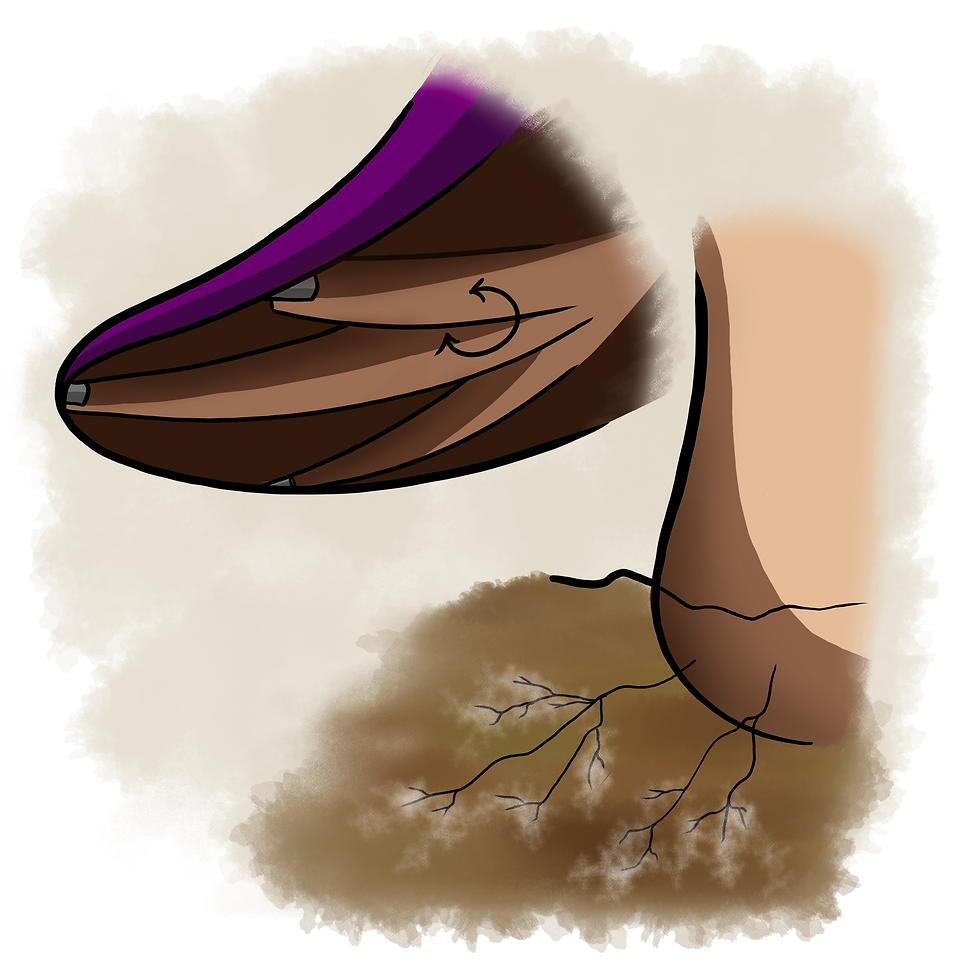
In addition to monitoring soil quality, Persephone possesses the capability to assess air quality to a certain extent. It ensures that nitrogen levels in the air remain within acceptable limits and identifies the types of spores drifting through the atmosphere. This functionality proves invaluable in detecting potentially harmful fungi that could pose a threat to the ecosystem or uncovering extinct species of fungi. Persephone accomplishes this through its specialized gills, which also enable the fungi to generate and store its own energy. This energy is derived from solar power, wind, and tapping into the Wood Wide Web (WWW).
Persephone's cap is equipped with solar cells that generate power, while its gills can move in the wind akin to a wind turbine. In cases of extreme power depletion, Persephone taps into a fungi network to request an electrical current, thereby replenishing its energy reserves. In return, this network can supply additional neutrinos to the fungi, reciprocating the assistance provided by Persephone.